
Airbnb Tax Loophole Explained: How It Works, Who Qualifies and What Audits Look For
The Airbnb tax loophole is a set of IRS rules that can let a short-term rental owner treat rental losses as non-passive. If the average guest stay is 7 days or less and you materially participate in running the property, the loss (often boosted by cost segregation and bonus depreciation) can be used against other income, such as a W-2 salary, instead of being trapped as a passive loss.
Airbnb Tax Loophole: Quick Answer
- What it is: the Airbnb tax loophole is not an actual loophole, but a legal result of how the passive activity rules treat short-term rentals.
- The three gates: (1) average stay of 7 days or less, (2) you materially participate, (3) you do not provide substantial hotel-like services (otherwise it is reported as a business with self-employment tax).
- The accelerator: a cost segregation study plus bonus depreciation can create a large first-year paper loss.
- Biggest risk: weak records. Most disputes come down to proving your hours and your average stay.
- Rental arbitrage: you can still use parts of it, but you do not own the building, so you cannot depreciate it. See the rental arbitrage section below.
What the Airbnb Tax Loophole Actually Is
Search for the “Airbnb tax loophole” or “STR loophole” and you will find the same idea: some people use a short-term rental to cut their tax bill on other income. There is no special law with that name. It is the combination of three ordinary tax rules:
- Passive activity rules: rental income and losses are normally “passive”, which means losses can generally only offset passive income.
- The short-stay exception: when the average customer stay is 7 days or less, the activity is not treated as a “rental activity” for the passive loss rules. It is then tested like any other business.
- Depreciation: buildings and furnishings lose value on paper each year, and faster methods (cost segregation, bonus depreciation) front-load those deductions.
If you materially participate in the business, the loss becomes non-passive and may offset wages or business income. Whether that is allowed for you depends on your facts, which is why a CPA should confirm it.
Why Passive vs Non-Passive Matters
Long-term rentals are passive by default. A $30,000 paper loss from depreciation on a long-term rental typically sits unused (carried forward) if you have no other passive income. With the Airbnb tax loophole, a short-term rental that passes the tests below can instead be non-passive, so that same loss can reduce taxable income this year.
| Item | Typical long-term rental | Qualifying short-term rental |
|---|---|---|
| Passive activity treatment | Passive by default | Not a “rental activity” if average stay is 7 days or less |
| Losses offset wages? | Generally no (limited exceptions) | Yes, if you materially participate |
| Reporting form | Schedule E | Usually Schedule E; Schedule C if you provide substantial services |
| Self-employment tax | No | No, unless substantial services are provided |
The Three Gates of the Airbnb Tax Loophole
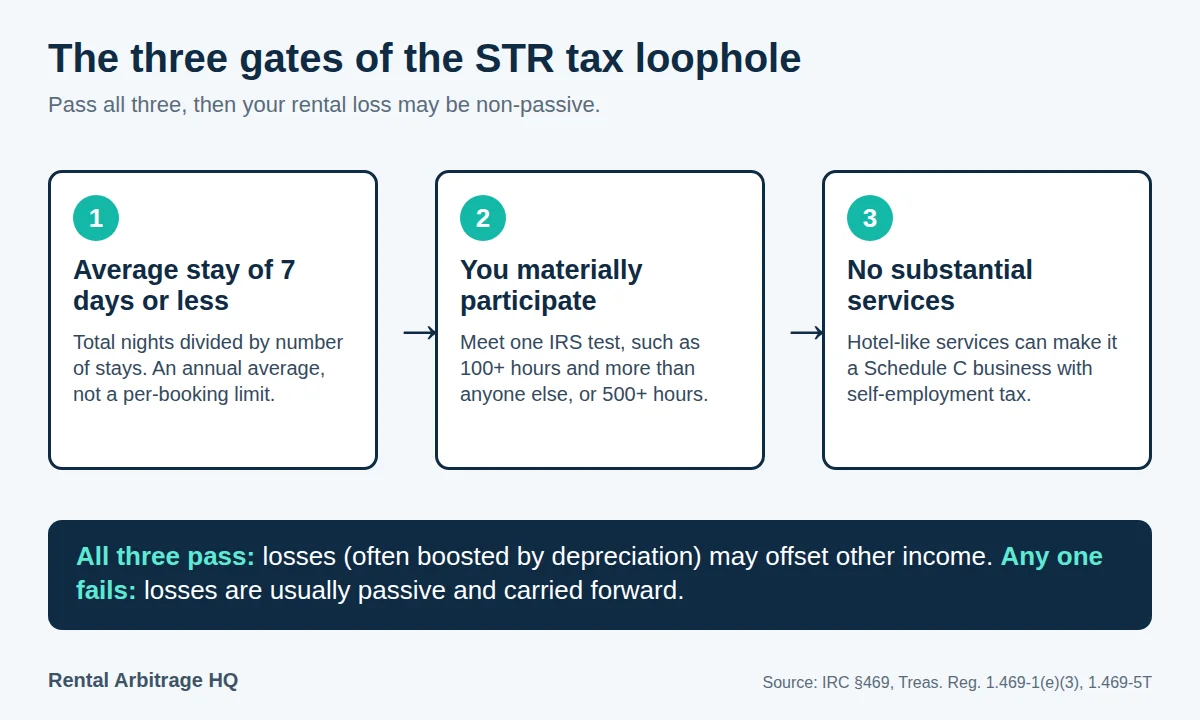
Gate 1: Average Guest Stay of 7 Days or Less
This is the “short-term” test. It is an average across the year, not a rule that every booking must be under 7 days. A few long stays can be offset by many short ones. See the calculation below.
Gate 2: You Materially Participate
Owning the property is not enough. You must be involved in the operation on a regular, continuous and substantial basis, measured by the IRS tests in the next section.
Gate 3: No Substantial Services
Providing hotel-like services (daily cleaning, meals, concierge) can turn the activity into a trade or business reported on Schedule C, which adds self-employment tax. Normal host tasks such as turnover cleaning between guests, utilities and supplies are generally not treated as substantial services, but the line depends on facts, so ask a CPA.
How to Calculate Your Average Stay
Average stay is total rental days divided by number of separate stays during the year. Keep your booking export as proof.
| Stays | Count | Nights each | Total nights |
|---|---|---|---|
| Weekend stays | 40 | 2 | 80 |
| Week-long stays | 15 | 7 | 105 |
| Monthly stays | 2 | 30 | 60 |
| Total | 57 | 245 |
Average stay = 245 ÷ 57 = 4.3 days. This passes Gate 1 even though two stays were 30 nights. Note that a long-stay-heavy calendar (many 30-day bookings) can push the average above 7 days quickly, so check this number each quarter, not just in April.
Tip: export your Airbnb, VRBO and direct-booking data into one spreadsheet and calculate this at year end. Use our calculators for profit and ROI planning.
Material Participation: The Tests and Hours
The IRS provides seven tests. Meeting any one is enough. The two that short-term rental owners usually rely on are the 500-hour test and the “100 hours and more than anyone else” test.
| Test | In plain English | Common for STR owners? |
|---|---|---|
| 1. 500 hours | You work more than 500 hours in the year on the activity | Yes |
| 2. Substantially all participation | Your work is substantially all of the work done by anyone | Sometimes, if you self-manage |
| 3. 100 hours and more than anyone else | You work over 100 hours, and no one else (including cleaners and managers) works more than you | Yes, the most common |
| 4. Significant participation activities | Several activities add up to over 500 hours | Rarely |
| 5. 5 of last 10 years | You materially participated in 5 of the past 10 years | No |
| 6. Personal service activity | Applies to fields like law, health, consulting | No |
| 7. Facts and circumstances | Over 100 hours and regular, continuous, substantial involvement | Rarely relied on |
The Cleaner Problem (Test 3)
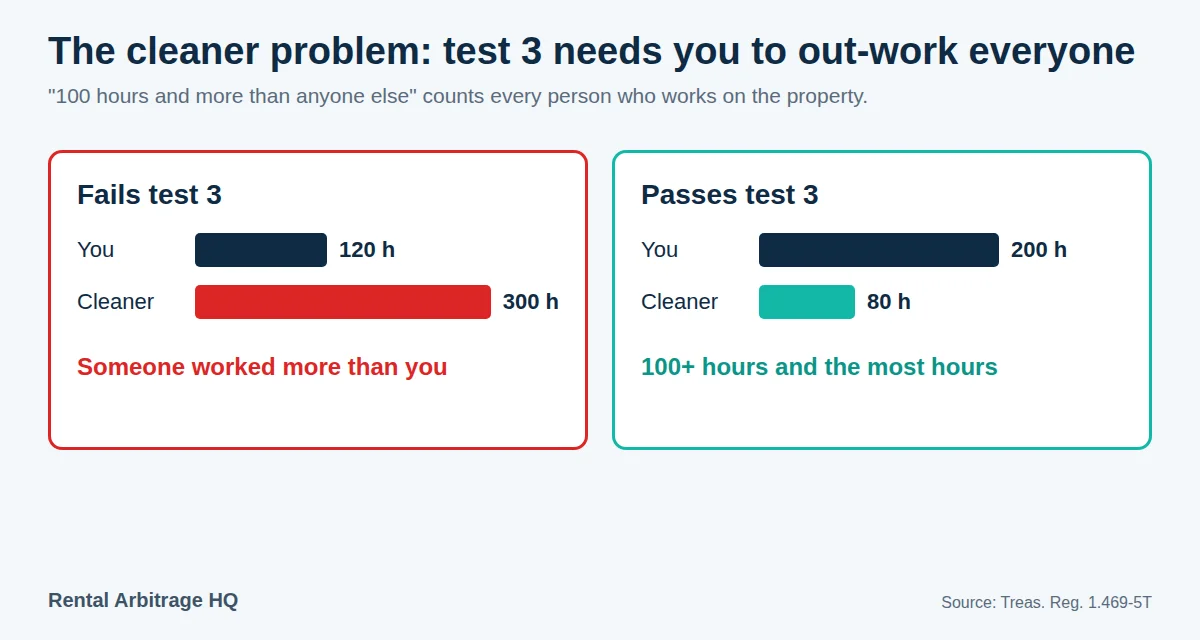
If your cleaners log 300 hours on turnovers and you log 120, you fail test 3, because someone else worked more than you. This is a common trap. Track who does what, and consider doing more of the work yourself during the year in which you want the loss.
What Counts as Hours
Guest messaging, pricing and calendar management, booking admin, ordering supplies, coordinating cleaners and repairs, bookkeeping for the property, and doing turnovers or maintenance yourself generally count as work on the activity. Investor-type activities (reviewing statements, researching whether to buy) generally do not count unless you are directly involved in day-to-day management.
If you hire a property manager to handle most of the work, you will probably struggle to show material participation. Spouses’ hours can be combined for these tests.
Time Log Template (Use This From Day One)
Courts have repeatedly rejected after-the-fact estimates. A contemporaneous log is the single most useful thing you can keep. Copy this into a spreadsheet:
| Date | Property | Task | Hours | Who | Evidence |
|---|---|---|---|---|---|
| 2026-03-04 | Lake House | Guest messaging and pricing review | 1.5 | Owner | Airbnb message log |
| 2026-03-06 | Lake House | Turnover cleaning | 3.0 | Owner | Photo of checklist |
| 2026-03-09 | Lake House | Cleaner turnover | 3.5 | Cleaner | Invoice |
Log your cleaners’ and handymen’s hours as well. You need those totals to show you worked more than anyone else.
Cost Segregation and Bonus Depreciation
Cost segregation is what turns the Airbnb tax loophole from a small tax benefit into a large first-year deduction.
Normally a building is depreciated slowly over decades. A cost segregation study splits the purchase price into components: land (not depreciable), the building shell (slow), and shorter-life items such as appliances, carpets, fixtures and land improvements (5, 7 or 15 years). Shorter-life property can be eligible for bonus depreciation, which allows a large share of the cost to be deducted in the first year.
Bonus depreciation rules have changed several times in recent years. Confirm the percentage that applies to the property and the date you placed it in service with a CPA before you rely on a figure from any website, including this one.
Things to know before buying a study:
- Depreciation is not a free pass. Selling the property can trigger depreciation recapture, so it often defers tax rather than erasing it.
- A study costs money. It usually only makes sense when the first-year deduction is large relative to the cost, and when you can actually use the loss.
- Furniture and equipment you buy for the rental are separate from the building and may qualify for faster write-offs on their own.
Worked Example (Illustrative Numbers)
This is a simplified, hypothetical example to show the mechanics. It is not a prediction of your result.
| Item | Amount |
|---|---|
| Purchase price | $500,000 |
| Land (not depreciable), assumed 20% | $100,000 |
| Depreciable basis | $400,000 |
| Portion identified as short-life property, assumed 25% | $100,000 |
| First-year deduction if fully eligible for bonus depreciation | $100,000 (plus regular depreciation on the rest) |
| Rental income minus cash expenses, assumed | $20,000 profit |
| Net paper loss | About $80,000 before the building’s regular depreciation |
| Tax effect if the owner is in a 32% bracket and the loss is usable | About $25,600 less tax in year one |
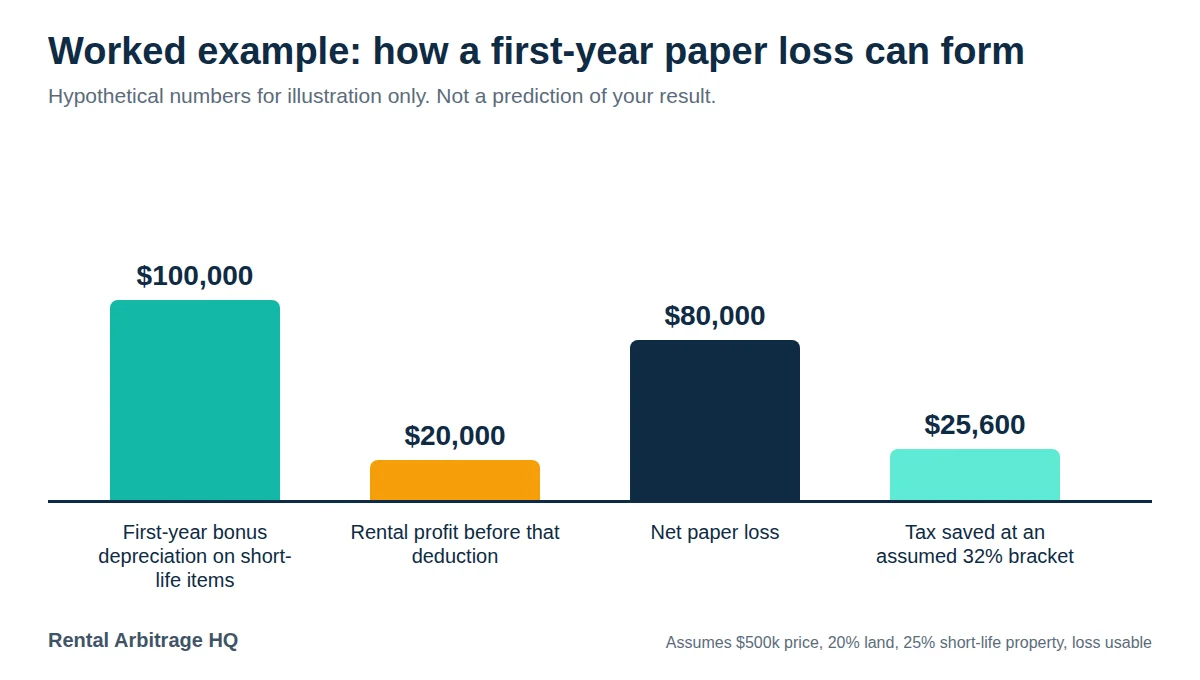
Important limits: the loss can only be used if you pass all three gates, and other rules (such as the limit on excess business losses and basis and at-risk rules) can cap the deduction. Unused losses carry forward.
Loophole vs Real Estate Professional vs the 14-day Rule
The Airbnb tax loophole, real estate professional status and the 14-day rule are often confused. They are separate strategies.
| STR “loophole” | Real estate professional status | 14-day rule (Augusta rule) | |
|---|---|---|---|
| Main requirement | Average stay of 7 days or less + material participation | More than 750 hours in real estate trades and more than half of your working time | Rent your home for under 15 days a year |
| Works for a full-time W-2 employee? | Yes, in principle | Very hard | Yes |
| Benefit | Losses may offset other income | Rental losses become non-passive | Rental income is tax-free |
| Deductions allowed | Yes | Yes | No rental deductions |
Does It Work for Rental Arbitrage?
Many pages about this topic ignore rental arbitrage, where you lease a property and re-rent it short-term. Does the Airbnb tax loophole work for rental arbitrage? Partly.
- The building: you do not own it, so there is no building depreciation and no cost segregation study. Most of the “big first-year deduction” does not apply.
- The passive rules: the 7-day average stay and material participation tests can still apply to your operating activity, so a loss may be non-passive. Whether an arbitrage operation qualifies depends on your facts.
- What you can usually deduct: rent paid to your landlord, utilities, platform fees, cleaning, supplies and insurance, plus furniture and equipment you buy, which may be depreciated or written off faster.
- Services: because arbitrage hosts often provide more services, check Gate 3 carefully.
Before you start, confirm that your lease allows subletting and short-term stays. Read our legal location guides for local permit and registration rules, and use our arbitrage calculators to test whether the numbers work before worrying about tax strategy.
State Tax Differences
Federal rules are only half of the picture for the Airbnb tax loophole. Some states do not follow federal bonus depreciation, and some tax short-term rental income in other ways (state income tax, lodging or occupancy taxes, sales tax). Local rules such as city registrations and caps can also decide whether you can run the rental at all. Check your state tax agency and your city’s short-term rental rules, and see your state page in our legal database.
Audit-Proofing: Records and Checklist
Disputes over this strategy usually come down to evidence. Keep these records for the number of years your tax advisor recommends:
- A contemporaneous time log, including cleaners’ and managers’ hours.
- Booking exports showing every stay and the average stay calculation.
- Purchase documents, closing statement and the land versus building split.
- The cost segregation report (if used) and placed-in-service date.
- Invoices and receipts for furniture, repairs and services.
- Any management agreement showing what the manager does and does not handle.
- Proof that you did not provide substantial services, or the Schedule C treatment if you did.
- Personal use log, because personal use can limit deductions.
Quick Self-Check Before Filing
- Is my average stay 7 days or less (calculated and saved)?
- Which material participation test do I meet, and do my logs prove it?
- Do I know who worked the most hours, me or my cleaner or manager?
- Have I confirmed with a CPA whether services make this a Schedule C activity?
- Do I understand how the loss interacts with other limits?
Common Mistakes
- Treating the Airbnb tax loophole as automatic. You have to pass all three gates every year, and be able to prove it.
- Hiring a full-service manager and still claiming you materially participated.
- Estimating hours at tax time instead of logging them as you go.
- Letting the average stay creep above 7 days by accepting too many monthly bookings.
- Buying a cost segregation study without being able to use the loss.
- Ignoring recapture when you sell.
- Assuming one blog’s number is current without checking the rules for your tax year.
- Ignoring local law: a deduction is worthless if the city does not let you operate.
Who Should Not Use This Strategy
- People who cannot realistically track and work the hours required.
- Owners who rely on a full-service property manager.
- Anyone whose average stay is mostly 30 days or more.
- People who cannot use the loss this year and would pay for a study they cannot benefit from.
- Anyone who plans to claim the Airbnb tax loophole without records.
Frequently Asked Questions
- What Is the Short-Term Rental Loophole?
- It is the result of three rules working together: an average guest stay of 7 days or less takes the property out of the "rental activity" category for passive loss purposes, material participation makes the activity non-passive, and depreciation (often accelerated) creates losses that can offset other income.
- What Qualifies a Property as a Short-Term Rental for Tax Purposes?
- For the passive loss exception, the average customer stay must be 7 days or less. This is an annual average. There is a separate rule for an average stay of 30 days or less with significant personal services, so check which applies to you.
- What Is the Difference Between an Airbnb and a Short-Term Rental?
- Airbnb is a booking platform. A short-term rental is the property and the type of use. The tax rules look at the average length of stay and the services you provide, not at which platform you use.
- Do I Have to Be a Real Estate Professional to Use the Loophole?
- No. Real estate professional status is a different route with a much higher bar (more than 750 hours and more than half your working time). The short-term rental route relies on the average stay plus material participation.
- Can I Use It If I Have a Full-Time Job?
- It is possible in principle, because the tests are based on your hours, not your job title. The practical challenge is proving that you worked enough hours, and more than anyone else if you use test 3.
- Does the Airbnb Tax Loophole Avoid Self-Employment Tax?
- Generally yes, if you do not provide substantial services and report on Schedule E. If you provide hotel-like services, the activity may be reported on Schedule C with self-employment tax.
- What Are the Downsides of Short-Term Rentals From a Tax Perspective?
- Records are demanding, depreciation can be recaptured when you sell, losses may be limited by other rules, state rules can differ, and local regulations can restrict or ban the use.
- What Is the 80/20 Rule in Airbnb?
- There is no IRS "80/20 rule" for Airbnb hosts. The phrase is used loosely in hosting communities, and it has nothing to do with the tax strategy in this guide. The tax tests that matter are the 7-day average stay and material participation (for example, 100 hours and more than anyone else, or 500 hours).
- Is the Airbnb Tax Loophole Legal?
- Yes, when you meet the requirements and keep proper records. The risk is not that the strategy is illegal, but that a claim without evidence can be disallowed.
- Does Rental Arbitrage Qualify?
- Possibly for the passive-loss tests, but not for building depreciation or cost segregation, because you do not own the building.
Sources
- IRS Publication 925: Passive Activity and At-Risk Rules
- IRS Publication 527: Residential Rental Property
- IRS Publication 946: How to Depreciate Property
- 26 U.S. Code Section 469: Passive activity losses and credits limited
- Treasury Regulation 1.469-1 (including the average-stay rules in paragraph (e)(3))
- Treasury Regulation 1.469-5T: Material participation