
Does Renters Insurance Cover Airbnb? 7 Essential Facts to Know
Airbnb has changed the way people travel by making it easier to find temporary accommodation in residential properties. Whether someone is booking a vacation home, staying in an apartment for work, or renting a private room, insurance protection is an important consideration. A theft, accidental injury, or property damage incident can create unexpected financial responsibilities for both guests and hosts.
Does renters insurance cover Airbnb? In some situations, yes. A standard renters insurance policy may extend personal property protection and certain liability coverage to temporary accommodations, including Airbnb stays. However, coverage depends on the policy’s terms, exclusions, and the circumstances of the incident.
The situation is different for property owners. Homeowners insurance is primarily designed for residential properties, and regular short-term rental activity may fall outside the protection provided by a standard policy.
Understanding does renters insurance cover Airbnb is therefore important for travelers who want to protect their belongings and homeowners who want to rent their properties safely. This guide explains the available coverage, common exclusions, specialized insurance options, and the differences between traditional insurance and Airbnb’s protection programs.
1. Understanding Renters Insurance Coverage for Airbnb Stays
Renters insurance protects tenants against certain financial losses involving personal belongings and personal liability. Although it is primarily associated with a permanent rental residence, some coverage can extend beyond the insured property.
This is particularly relevant when considering does renters insurance cover Airbnb accommodation during a vacation or temporary stay.
For example, someone who rents an apartment may travel to another city and book an Airbnb for a week. If their personal belongings are stolen from that temporary accommodation, their existing renters insurance policy may provide protection.
However, the policy does not automatically cover every incident that happens during an Airbnb stay. The type of loss, coverage limits, exclusions, and policy conditions all matter.
Personal Property Coverage During Temporary Stays
Personal property coverage protects belongings such as clothing, laptops, smartphones, cameras, furniture, and other possessions against specified covered risks.
Many renters insurance policies include off-premises personal property coverage. This means eligible belongings may remain protected even when temporarily taken outside the insured residence.
For instance, imagine that someone books an Airbnb for a vacation and a burglar steals their laptop, camera, and clothing. Their renters insurance may cover the stolen belongings if theft is a covered peril and the policy’s requirements are satisfied.
Before relying on this protection, consider the following:
-
Covered events: The incident must involve a cause of loss included in the policy.
-
Off-premises limits: Some policies impose lower limits on belongings located outside the insured residence.
-
High-value possessions: Jewelry, collectibles, and expensive electronics may have special coverage limits.
-
Deductibles: The deductible determines how much the policyholder pays before insurance contributes.
-
Documentation: Receipts, photographs, police reports, and ownership records may be required when submitting a claim.
It is also important to distinguish between personal belongings and the property owned by the Airbnb host. Renters insurance generally does not insure the host’s building, appliances, or furnishings.
According to the Insurance Information Institute’s renters insurance guide, renters insurance can provide protection for personal belongings and liability, subject to policy terms and coverage limitations.
Personal Liability Coverage for Airbnb Guests
Personal liability coverage may protect a policyholder if they accidentally injure someone or damage another person’s property and become legally responsible.
For example, a guest might accidentally damage a neighboring apartment or cause an injury to another person during their stay.
However, damage to property rented, occupied, or in the care of the insured may be excluded or subject to special limitations.
This is why does renters insurance cover Airbnb cannot be answered without considering the specific liability provisions in the policy.
Guests should ask their insurance provider whether personal liability protection applies to temporary rental accommodations and accidental damage involving an Airbnb property.
Coverage Limitations and Exclusions
Even when a renters insurance policy extends to an Airbnb stay, it does not provide unlimited protection.
Common limitations include:
-
Wear and tear: Gradual deterioration and maintenance problems are generally excluded.
-
Intentional damage: Deliberately damaging another person’s property is not an insured accidental loss.
-
Business activities: Certain business-related losses may fall outside standard personal insurance coverage.
-
High-value belongings: Certain valuables may have separate limits.
-
Host-owned property: The guest’s policy does not automatically insure the building or furnishings belonging to the host.
Does Renters Insurance Cover Airbnb Stays?
Yes, renters insurance may cover certain losses during an Airbnb stay, particularly eligible personal belongings stolen or damaged by a covered event. Some personal liability protection may also apply, depending on the circumstances.
However, does renters insurance cover Airbnb in every situation? No. Coverage depends on the policy’s off-premises property provisions, liability exclusions, deductibles, and other conditions.
Travelers should review their insurance documents before booking temporary accommodation and contact their insurer if they need clarification.
2. Homeowners Insurance and Airbnb Rentals
Homeowners insurance protects residential property owners against certain financial losses involving their homes, belongings, and personal liability.
However, homeowners insurance Airbnb coverage becomes more complicated when an owner starts renting out their property to paying guests.
A standard homeowners policy generally assumes that the property is being used primarily as a private residence. Short-term rental activity introduces additional risks, including guest-related property damage, injuries, and increased occupancy.
For example, an owner who occasionally allows relatives to stay in a spare bedroom has a different insurance situation from someone who regularly rents an entire house through Airbnb.
How Standard Homeowners Insurance Works
A typical homeowners insurance policy may include the following coverage categories:
| Coverage | What it generally protects |
|---|---|
| Dwelling coverage | The home’s structure and attached components |
| Other structures | Eligible detached garages, fences, and similar structures |
| Personal property | The homeowner’s belongings |
| Personal liability | Certain claims involving bodily injury or property damage |
| Loss of use | Additional living expenses following a covered loss that makes the home uninhabitable |
These protections are subject to policy limits, exclusions, deductibles, and conditions.
When a property becomes a short-term rental, the insurer may evaluate the additional exposure created by paying guests and frequent occupancy changes.
Rental Activity and Homeowners Insurance Exclusions
Some standard homeowners policies restrict coverage when a property is used for business or rental purposes.
Consider a homeowner who lists an entire house on Airbnb throughout the year. A guest accidentally starts a kitchen fire, damaging cabinets, appliances, and other parts of the property.
The homeowner might assume their existing insurance will cover everything. However, the insurer may investigate whether the property was being used for a disclosed rental activity and whether the policy covers that exposure.
Depending on the policy, rental activity may affect:
-
Dwelling and property damage coverage.
-
Personal liability protection.
-
Coverage for furnishings and household equipment.
-
Loss of rental income.
-
Eligibility for continued coverage under the existing policy.
Homeowners should disclose their rental arrangements to their insurance providers before accepting paying guests.
The National Association of Insurance Commissioners (NAIC) explains the insurance considerations homeowners should review before renting out their properties through home-sharing platforms.”
Occasional Home-Sharing vs. Regular Airbnb Rentals
Not all rental arrangements create the same insurance risks.
Occasional home-sharing: A homeowner occasionally rents a spare bedroom or their primary residence while traveling. Some insurers may offer a home-sharing endorsement for eligible arrangements.
Regular short-term rentals: A homeowner consistently rents an entire property to different guests. This may require a dedicated short-term rental or landlord insurance policy.
The distinction matters because insurers consider occupancy, rental frequency, property use, and liability exposure when determining coverage eligibility.
3. Homeowners Insurance for Short-Term Rentals
Homeowners insurance for short term rentals requires more careful consideration than ordinary residential insurance.
A property used for Airbnb hosting is exposed to risks associated with frequent guest turnover, temporary occupancy, accidental damage, and potential liability claims.
A traditional homeowners policy may not adequately address these risks. Depending on the property and rental arrangement, an insurer may recommend a home-sharing endorsement, landlord policy, or specialized short-term rental insurance.
This distinction is important when evaluating does renters insurance cover Airbnb alongside the insurance requirements of property owners. Guests and hosts have different insurance responsibilities.
Short-Term Rental Homeowners Insurance Options
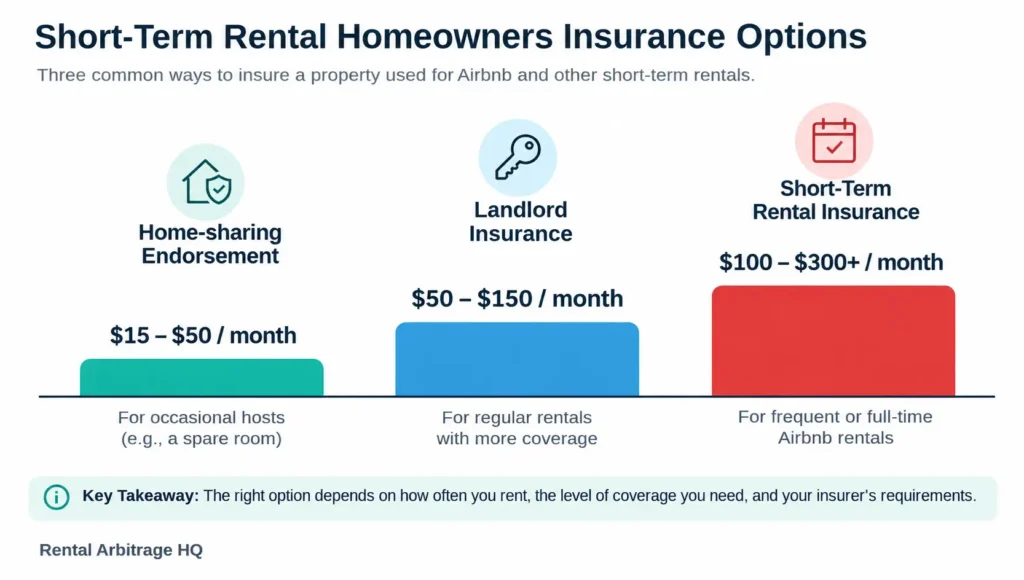
Property owners generally have several options for obtaining protection for Airbnb and similar rental activities.
1. Home-sharing endorsement
A home-sharing endorsement adds certain rental-related protections to an existing homeowners policy. It may be appropriate for eligible homeowners who occasionally rent a room or share their primary residence. Available protections vary by insurer and may include certain guest-related property damage or liability coverage.
2. Landlord insurance
A landlord policy is generally designed for property owners who rent residential properties to tenants. Depending on the policy, it may cover the dwelling, certain landlord-owned furnishings, liability claims, and loss of rental income following an insured event. However, a standard landlord policy may not automatically cover frequent short-term rentals. Confirm that Airbnb-style occupancy is permitted.
3. Specialized short-term rental insurance
Specialized policies are designed for properties used as vacation rentals or short-term accommodations. Depending on the insurer, coverage may include:
-
Building and structural protection.
-
Furniture, appliances, and other contents.
-
Guest-related liability claims.
-
Certain accidental property damage.
-
Loss of rental income following a covered loss.
-
Additional protection for rental-related risks.
Property Damage and Liability Protection
Two of the most important considerations for Airbnb hosts are property damage and liability protection.
Property damage coverage may protect the insured building and eligible furnishings against specified covered events. However, damage caused by paying guests must be specifically addressed in the policy.
Liability coverage may help protect a host if a guest suffers an injury and the host is legally responsible.
For example, a visitor might fall because of an unsafe staircase or an unaddressed maintenance problem.
A suitable policy should clearly explain how it handles guest injuries, property damage, legal expenses, and rental-related claims.
4. Vacation Home Rental Insurance Explained
Vacation home rental insurance is designed to address additional risks associated with owning a second property that may be rented to guests.
A vacation home is not necessarily occupied throughout the year. It may remain vacant for extended periods or be used by the owner during certain seasons and rented to visitors during others.
These occupancy patterns can affect the type of insurance required.
Primary Residence vs. Vacation Rental Property
A primary residence is generally the property where the homeowner lives most of the time. A vacation property is typically used for holidays, seasonal visits, or occasional personal stays.
When a vacation property is listed on Airbnb, its insurance requirements may change.
For example, a homeowner might own a beach house that they use during summer and rent to visitors during the remaining months. A standard second-home policy may not automatically cover the rental activity.
The insurer needs to know:
-
How frequently the property is rented.
-
How long guests typically stay.
-
Whether the owner also uses the property personally.
-
Whether the property is vacant between bookings.
-
Whether the rental activity is occasional or continuous.
Choosing Appropriate Vacation Home Rental Insurance
Before selecting vacation home rental insurance, property owners should consider the following:
-
Property protection: Does the policy cover the building, fixtures, appliances, and furnishings?
-
Guest liability: Are injuries involving paying guests covered?
-
Rental frequency: Does the policy permit occasional or continuous short-term rentals?
-
Loss of rental income: Can you recover eligible rental income lost after a covered event?
-
Vacancy conditions: Are there restrictions when the property remains unoccupied?
-
Additional structures: Are detached garages, pools, fences, and other structures included?
The right policy depends on the property’s use and the risks the owner wants to insure.
5. Homeshare Insurance Coverages and Protection Options
Homeshare insurance is designed for eligible homeowners who occasionally rent out part or all of their primary residence through home-sharing platforms.
Unlike traditional homeowners insurance, homeshare coverage addresses certain risks associated with allowing paying guests to stay in a residential property.
However, not every home-sharing endorsement offers the same protection. Coverage depends on the insurance provider, the endorsement, rental frequency, and the terms of the policy.
What Homeshare Insurance Coverages May Include
The following are common coverage areas that may be available through a home-sharing endorsement or specialized policy.
Property damage protection
This may cover eligible damage to the insured home, furnishings, or other covered property caused by specified events during a guest’s stay.
Guest liability protection
Liability coverage may help protect homeowners against certain claims if a guest is injured on the property and the homeowner is legally responsible.
Personal property protection
Some policies may cover eligible household belongings, furniture, and appliances against covered losses associated with home-sharing activities.
Theft and vandalism
Depending on the policy, certain theft or vandalism losses involving the property or its contents may be covered.
Loss of rental income
Some specialized policies offer coverage for lost rental income when a covered event makes the property unavailable for guests.
Not every homeshare endorsement includes all these protections. Homeowners should check the specific coverage limits, exclusions, and eligibility requirements.
Homeshare Insurance vs. Traditional Homeowners Insurance
| Feature | Traditional homeowners insurance | Homeshare insurance |
|---|---|---|
| Primary residence protection | Yes, subject to policy terms | May be included through the underlying policy |
| Personal belongings | Covered against specified risks | May include additional home-sharing provisions |
| Guest-related liability | May be restricted | May provide additional eligible protection |
| Short-term rental activity | Often restricted | Designed for eligible home-sharing arrangements |
| Rental income protection | Usually limited or unavailable for this purpose | May be available depending on the policy |
The important distinction is that homeshare insurance is intended to address certain risks created by hosting paying guests, whereas standard homeowners insurance primarily addresses residential ownership risks.
6. Airbnb AirCover vs. Traditional Insurance
Airbnb offers a protection program called AirCover for Hosts. It provides certain protections to eligible hosts when they accept bookings through the platform.
However, AirCover should not be confused with a complete homeowners insurance or short-term rental insurance policy.
AirCover for Hosts includes Host Damage Protection and Host Liability Insurance, among other hosting safeguards. The program’s terms, eligibility requirements, and limitations determine how protection applies.
Host Damage Protection
Airbnb’s Host Damage Protection provides protection for certain damage caused by guests or their invitees to a host’s home and belongings, subject to the program’s terms.
Eligible protection may include:
-
Damage to the home and furnishings.
-
Damage to certain valuables and collectibles.
-
Damage to certain vehicles and boats at the property.
-
Certain additional cleaning expenses.
-
Certain lost rental income when confirmed bookings must be canceled because of guest damage.
However, Host Damage Protection is not an insurance policy. It is a contractual protection program subject to Airbnb’s terms, conditions, and exclusions.
For example, normal wear and tear and ordinary checkout cleaning are not covered under this program.
Host Liability Insurance
Airbnb also provides Host Liability Insurance for certain incidents involving guests or other people, subject to applicable coverage terms.
Examples of potentially covered claims include:
-
Bodily injury to a guest.
-
Damage to or theft of a guest’s belongings.
-
Certain property damage involving common areas or nearby properties.
The coverage is subject to the applicable insurance policy’s conditions and exclusions. Intentional damage and damage to the host’s own property are not covered under Host Liability Insurance.
Why AirCover Does Not Replace Traditional Insurance
AirCover can provide useful additional protection, but it does not replace a host’s existing insurance arrangements.
For example, a host may need separate coverage for:
-
The building and its structural components.
-
Personal belongings and rental furnishings.
-
Damage caused by events unrelated to an Airbnb guest.
-
Liability exposures outside the scope of AirCover.
-
Rental operations that require specialized insurance.
AirCover should therefore be treated as an additional layer of protection rather than a complete replacement for appropriate homeowners or short-term rental insurance.
7. Common Insurance Exclusions for Airbnb Properties
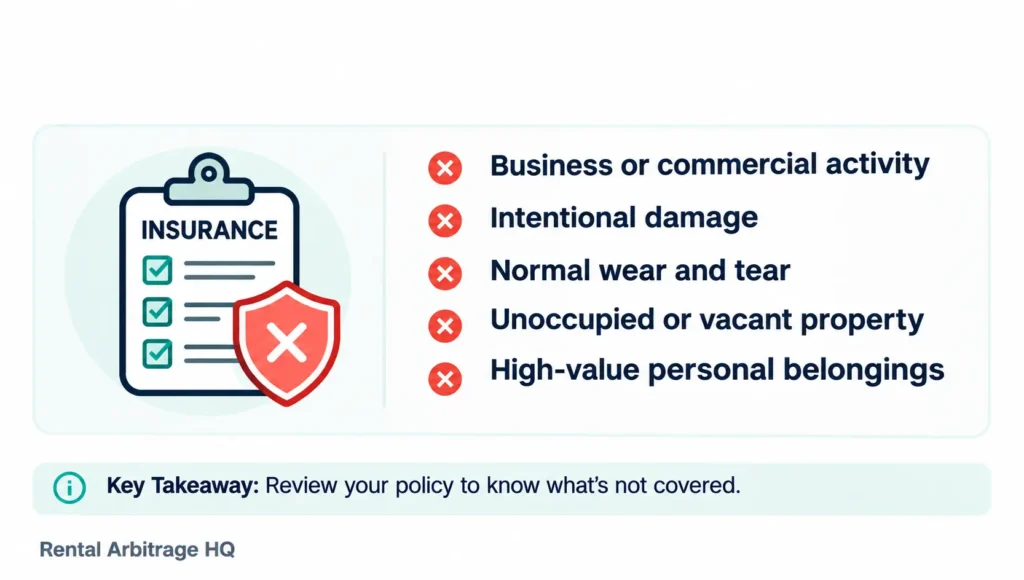
Understanding insurance exclusions is just as important as understanding what a policy covers.
Even if a homeowners or renters insurance policy provides some protection during an Airbnb stay, certain activities, incidents, and property types may be excluded or subject to restrictions.
The following are common areas that require particular attention.
Business and Commercial Activity
Some standard residential insurance policies restrict coverage for business activities conducted from the insured property.
Regularly renting out a property through Airbnb may be considered a business or rental activity, depending on the policy and circumstances.
A homeowner who does not disclose regular hosting activity may encounter coverage problems when filing a claim.
Intentional Damage
Insurance generally covers eligible accidental losses, not deliberate damage.
For example, if a guest intentionally breaks furniture or damages walls, the homeowner cannot automatically assume their personal homeowners policy will cover the incident.
Specialized rental coverage or Airbnb’s Host Damage Protection may provide a separate route for certain eligible guest-caused damage.
Normal Wear and Tear
Gradual deterioration is generally not an insured event.
Examples include:
-
Faded carpets.
-
Worn-out furniture.
-
Peeling paint caused by age.
-
Gradually deteriorating appliances.
-
Routine maintenance problems.
Property owners should distinguish between accidental damage and ordinary maintenance expenses.
Unoccupied or Vacant Properties
Vacation homes and second properties may remain unoccupied for extended periods. Some insurance policies impose conditions or limitations when a property is vacant or unoccupied beyond a specified period. Homeowners should review these provisions, particularly if their Airbnb property is rented seasonally.
High-Value Personal Belongings
Certain policies impose special limits on valuable items such as jewelry, artwork, collectibles, and electronics. Hosts who furnish an Airbnb with expensive equipment or decorative items should confirm whether their insurance provides adequate coverage.
8. Choosing the Right Insurance for Airbnb Guests and Hosts
The appropriate insurance depends on whether you are booking an Airbnb or renting out your own property.
Guests generally need protection for their personal belongings and liability, while hosts need protection for their property, furnishings, rental activity, and potential liability claims.
Understanding does renters insurance cover Airbnb is only one part of choosing the right protection. The policy should also match the specific risks associated with the accommodation and the travel arrangement.
Insurance Considerations for Airbnb Guests
If you regularly book Airbnb accommodations, review your existing renters or homeowners insurance before traveling.
Consider the following steps:
-
Review personal property coverage: Confirm whether your belongings are covered while staying temporarily outside your residence.
-
Check off-premises limits: Find out whether special limits apply to belongings taken on vacation.
-
Review liability protection: Ask whether your personal liability coverage extends to accidental damage involving a rented property.
-
Understand your deductible: Determine how much you would pay before insurance contributes to an eligible claim.
-
Document valuable belongings: Keep photographs, receipts, and records of expensive possessions.
If you are unsure whether renters insurance covers Airbnb accommodation in your particular circumstances, ask your insurer to confirm the applicable provisions before traveling.
Insurance Considerations for Occasional Airbnb Hosts
Homeowners who occasionally rent a room or their primary residence should contact their insurer before listing the property.
Ask whether a home-sharing endorsement is available and whether it covers guest-related damage, liability claims, and eligible property losses.
Also check whether the insurer imposes limits on the number of rental days or the type of accommodation being offered.
Insurance Considerations for Frequent Short-Term Rental Operators
Property owners who regularly operate Airbnb rentals may need a specialized short-term rental policy.
Before purchasing coverage, compare:
-
Dwelling and structural coverage.
-
Contents and furnishings protection.
-
Guest liability limits.
-
Property damage provisions.
-
Loss of rental income.
-
Vacancy restrictions.
-
Deductibles and exclusions.
-
Coverage for multiple rental properties, if applicable.
A policy designed for occasional home-sharing may not be suitable for a full-time vacation rental business.
Choosing the right coverage can be confusing, especially when comparing homeowners insurance, landlord policies, and specialized short-term rental protection. Use our Short-Term Rental Insurance Checker to help evaluate your insurance requirements as an Airbnb host.
Questions to Ask Your Insurance Provider
Before purchasing or renewing insurance, ask your provider:
-
Does my current policy permit Airbnb hosting?
-
Is occasional home-sharing treated differently from regular short-term rentals?
-
Are guest-caused property damage and theft covered?
-
Does liability protection apply to guest injuries?
-
Is lost rental income included?
-
Do I need a separate landlord or short-term rental policy?
-
Are there limits on the number of rental days?
The National Association of Insurance Commissioners also recommends reviewing homeowners insurance, home-sharing platform protection, and available additional coverage before renting out a property.
Final Thoughts: Understanding Airbnb Insurance Coverage
So, does renters insurance cover Airbnb? The answer depends on whether you’re protecting your personal belongings as a guest or insuring a property as a host.
For Airbnb guests, renters insurance may provide personal property protection and certain liability coverage during a temporary stay. However, it does not automatically cover every type of accidental damage or replace the host’s property insurance.
For homeowners, standard homeowners insurance may not provide sufficient protection when a property is regularly rented to paying guests. A home-sharing endorsement, landlord policy, or specialized short-term rental insurance may be necessary.
Airbnb’s AirCover for Hosts can provide additional protection, but it should not be treated as a replacement for a comprehensive insurance policy.
Before booking an Airbnb or listing your property, review your existing coverage, understand the exclusions, and speak with your insurance provider. Taking these steps can help you avoid unexpected expenses and choose protection that matches your actual needs.
Frequently Asked Questions
- Does Renters Insurance Cover Airbnb Theft?
- Yes, renters insurance may cover personal belongings stolen during an Airbnb stay if theft is a covered peril under the policy. However, off-premises coverage limits, deductibles, and exclusions may apply.
- Can I Host Airbnb Guests With Regular Homeowners Insurance?
- Possibly, but you should not assume your standard homeowners policy covers short-term rental activity. Contact your insurer to determine whether you need a home-sharing endorsement or a separate rental policy.
- Does Airbnb AirCover Replace Homeowners Insurance?
- No. AirCover for Hosts provides specific host protections, but it does not replace homeowners insurance or specialized short-term rental coverage.
- Do Airbnb Hosts Need Additional Liability Insurance?
- They may. Hosts should evaluate their existing liability limits and determine whether additional coverage is necessary for guest injuries, property damage, and other rental-related claims.
- What Insurance Is Best for a Vacation Rental Property?
- The best option depends on how the property is used. Occasional hosts may qualify for a home-sharing endorsement, while frequent short-term rental operators may need specialized vacation rental or landlord insurance that explicitly permits short-term stays.
- Does Renters Insurance Cover Accidental Damage to an Airbnb?
- Not necessarily. Personal liability coverage may apply in some situations, but damage to property rented or occupied by the insured can be restricted or excluded. Check the policy's property damage provisions.
- Does Renters Insurance Cover Airbnb Stays in Another State?
- It may. Some renters insurance policies extend personal property coverage beyond the insured residence, including while traveling. However, geographical restrictions and policy-specific conditions may apply.