
How to Start a Successful Airbnb Cleaning Business: Costs, Contracts, and Profitability
Starting an Airbnb cleaning business can be an attractive opportunity for entrepreneurs looking to enter the short-term rental industry without purchasing or leasing properties. Airbnb hosts need reliable cleaners to prepare their rentals between guest stays, creating demand for professional turnover services. But is an Airbnb cleaning business profitable, and what does it take to build one? This guide explores startup costs, cleaning equipment, housekeeping services, laundry operations, licensing requirements, pricing strategies, and practical ways to secure contracts with Airbnb hosts and property managers.
What Is an Airbnb Cleaning Business?
An Airbnb cleaning business provides professional cleaning and housekeeping services to owners and managers of short-term rental properties. Unlike traditional residential cleaning, which may happen weekly or monthly, vacation rental cleaning is usually scheduled around guest checkouts and upcoming reservations.
The main objective is to make every property clean, organized, sanitized, and ready for the next guest before the scheduled check-in time.
A typical Airbnb cleaning business may provide:
- Turnover cleaning: Cleaning the property after guests check out and before new guests arrive.
- Airbnb housekeeping: Making beds, replacing towels, restocking toiletries, and organizing living spaces.
- Laundry services: Washing, drying, folding, and replacing bed sheets, pillowcases, and towels.
- Deep cleaning: Performing detailed cleaning of kitchens, bathrooms, appliances, carpets, and other areas.
- Restocking supplies: Replacing essential items such as toilet paper, soap, coffee, and paper towels.
- Property inspections: Checking for damage, missing items, maintenance issues, and forgotten belongings.
An Airbnb cleaning business can operate independently or employ a small team of cleaners to manage multiple properties.
The business generally earns revenue through fixed per-turnover charges, hourly cleaning rates, or recurring service agreements with property owners.
Why Is an Airbnb Cleaning Business a Good Opportunity?
Short-term rental properties operate differently from traditional residential rentals. A property may accommodate several different guests within a single week, and every reservation creates another turnover requirement.
This creates an opportunity for professional cleaning companies that can provide consistent service within tight scheduling windows.
1. Recurring Demand for Cleaning Services
A property that receives regular bookings requires cleaning after guest departures. Hosts who manage multiple properties may need several turnovers every week. Instead of constantly searching for individual customers, a cleaning company can develop recurring relationships with hosts and vacation rental management companies.
However, cleaning frequency depends on occupancy, booking patterns, and the length of guest stays.
2. Multiple Revenue Opportunities
An Airbnb cleaning business does not have to rely exclusively on standard turnover cleaning. Additional services can increase the average value of each customer relationship.
For example, a cleaning company may charge separately for:
- Standard turnover cleaning.
- Linen and towel replacement.
- Laundry pickup and delivery.
- Deep cleaning.
- Refrigerator and oven cleaning.
- Emergency cleaning.
- Supply restocking.
Offering several services allows a company to serve different property requirements without depending on a single revenue source.
3. Relatively Low Initial Investment
Compared with opening a physical retail store or investing in rental properties, a small cleaning operation can begin with basic equipment and a limited number of employees. A new business can initially operate with one or two cleaners, a transportation arrangement, cleaning supplies, and a simple booking system. As the customer base grows, additional equipment and employees can be introduced.
4. Opportunities to Build Long-Term Relationships
Property managers often prefer working with dependable service providers rather than hiring different cleaners for every reservation. An Airbnb cleaning business that consistently meets deadlines and maintains quality standards can develop long-term relationships with property owners, co-hosts, and vacation rental management companies. These relationships can create a more predictable flow of work.
How to Start an Airbnb Cleaning Business: Step-by-Step Guide
Starting a cleaning company requires more than purchasing cleaning products and advertising services. A successful operation needs a defined service area, clear pricing, reliable procedures, and a consistent customer acquisition strategy.
The following steps explain how entrepreneurs can establish an Airbnb cleaning business from the beginning.
Step 1: Research the Local Short-Term Rental Market
Before investing in equipment or hiring employees, the business owner should understand the local vacation rental market.
Research should identify:
- The number of active short-term rental properties.
- Popular neighborhoods for vacation rentals.
- Average property sizes.
- The number of local Airbnb hosts and property managers.
- Existing cleaning service providers.
- Typical cleaning rates.
- Seasonal demand patterns.
A market with several vacation rentals and limited professional cleaning providers may offer better opportunities than an area with very little short-term rental activity.
Local Airbnb listings, property management websites, and vacation rental directories can help identify potential customers.
Step 2: Choose the Services to Offer
A new company should establish a clear service package rather than offering every possible cleaning task immediately.
A basic service package may include:
| Service | Main responsibilities |
|---|---|
| Turnover cleaning | General cleaning after guest checkout |
| Bathroom cleaning | Sanitizing toilets, showers, sinks, and surfaces |
| Kitchen cleaning | Cleaning countertops, appliances, and dishes |
| Bedroom preparation | Making beds and replacing linens |
| Laundry service | Washing and folding towels and bedding |
| Restocking | Replacing essential guest supplies |
| Property inspection | Reporting damage and maintenance issues |
An Airbnb cleaning business can introduce additional services after understanding customer requirements and operational capacity.
Step 3: Purchase Essential Cleaning Equipment
The right equipment helps employees complete cleaning tasks efficiently and maintain consistent standards.
The initial equipment list generally includes:
- Commercial vacuum cleaner.
- Mop and bucket.
- Microfiber cloths.
- Scrubbing brushes.
- Glass cleaning tools.
- Disinfectants and surface cleaners.
- Bathroom cleaning products.
- Disposable gloves.
- Protective eyewear where necessary.
- Cleaning caddies.
- Trash bags.
- Laundry bags.
- Measuring containers for cleaning solutions.
The company should also maintain a separate inventory of replacement supplies. Cleaning products should be appropriate for the surfaces being treated. For example, certain products can damage natural stone, wooden furniture, and delicate finishes. The business should maintain product labels and follow manufacturer instructions.
Step 4: Create a Standard Cleaning Checklist
A standardized checklist is one of the most important operational tools for an Airbnb cleaning business. Without a defined process, employees may overlook important tasks, resulting in inconsistent cleaning quality. A typical turnover checklist includes:
Kitchen
- Clean countertops and kitchen surfaces.
- Wash dishes and empty the dishwasher.
- Clean the sink and faucet.
- Wipe appliances.
- Remove expired food.
- Empty trash bins.
- Sweep and mop the floor.
Bathrooms
- Clean and disinfect toilets.
- Scrub showers and bathtubs.
- Clean mirrors and sinks.
- Replace towels.
- Refill soap and toiletries.
- Check drains and visible plumbing issues.
Bedrooms
- Remove used bedding.
- Replace sheets and pillowcases.
- Make beds according to property standards.
- Dust furniture.
- Vacuum carpets.
- Check under beds and inside closets.
Living Areas
- Dust furniture and decorations.
- Clean frequently touched surfaces.
- Arrange cushions and furniture.
- Vacuum rugs and floors.
- Check television remotes and other guest amenities.
Final Inspection
- Confirm that all rooms are guest-ready.
- Check for forgotten belongings.
- Verify that supplies are restocked.
- Photograph any damage.
- Confirm that the property is ready before guest arrival.
An Airbnb cleaning business should provide its employees with digital or printed checklists to maintain consistency across different properties.
Step 5: Establish a Reliable Scheduling System
Time management is particularly important in short-term rental cleaning. A property may have a checkout at 10 a.m. and a new guest arriving at 4 p.m. This leaves a limited window for cleaning, laundry, inspection, and restocking. A scheduling system should record:
- Property addresses.
- Checkout and check-in times.
- Cleaning assignments.
- Expected cleaning duration.
- Employee availability.
- Laundry requirements.
- Special host instructions.
- Completion status.
Calendar applications and cleaning management software can help coordinate several properties. The business should also establish a backup arrangement for unexpected employee absences or additional cleaning requests.
What Licenses Are Needed to Start a Cleaning Business?
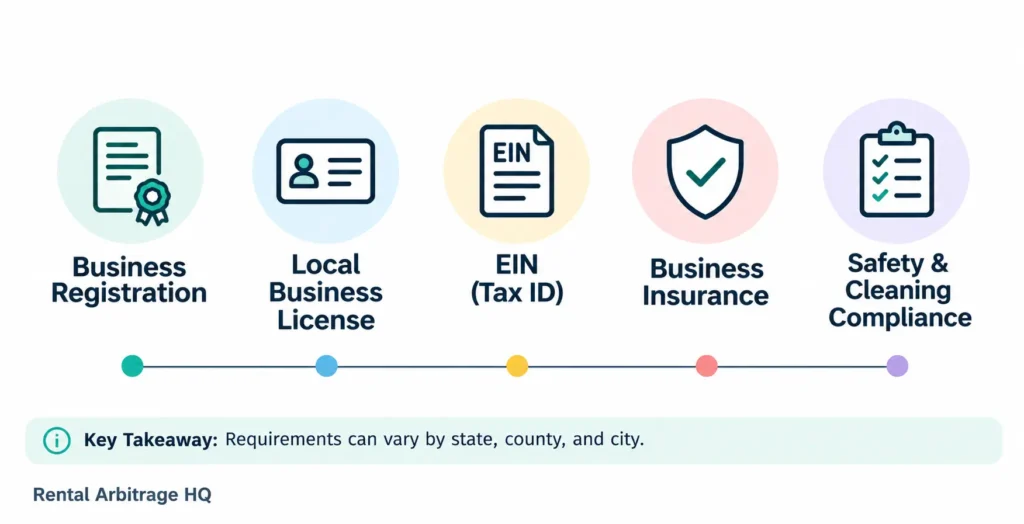
Understanding what licenses are needed to start a cleaning business is an important part of establishing a legitimate operation. In the United States, there is no single universal cleaning-business license that automatically applies to every company. Requirements depend on the state, county, city, business structure, and services offered. The U.S. Small Business Administration explains that licensing and permit requirements can vary according to business activity and location.
Common registration and compliance requirements may include:
1. Business Registration
The business owner may need to register the company with the appropriate state authority. Possible structures include:
- Sole proprietorship.
- Limited Liability Company (LLC).
- Partnership.
- Corporation.
An LLC is a common option for small businesses because it can provide liability separation when properly established and maintained. The appropriate structure depends on ownership, taxation, operating risks, and administrative requirements.
2. Local Business License
Some cities and counties require businesses to obtain a general business license before providing services. The requirements and fees differ between jurisdictions. A cleaning company should check with the relevant city clerk, county office, or state business registration authority before accepting customers.
3. Employer Identification Number (EIN)
An Employer Identification Number is a federal tax identification number issued by the IRS. It is generally required for businesses with employees, partnerships, and corporations. Some other businesses may also need one for banking or state tax purposes. The IRS provides a free application process through its official website:
Apply for an EIN through the IRS.
4. Insurance and Bonding
Insurance is not the same as a business license, but it is an important part of professional cleaning operations.
Common coverage options include:
- General liability insurance: Helps protect against certain third-party bodily injury and property damage claims.
- Workers’ compensation insurance: May be required when employees are hired, depending on state law.
- Commercial auto insurance: May be appropriate when vehicles are used for business activities.
- Janitorial bond: Can provide certain protections related to employee dishonesty, depending on the policy.
Hosts may prefer working with insured cleaning companies because employees regularly access private properties.
5. Cleaning Chemical and Workplace Safety Requirements
Companies employing cleaning workers should understand applicable workplace safety requirements. OSHA provides guidance on cleaning industry hazards, including chemical exposure, personal protective equipment, and safe working practices.
Employees should receive appropriate training on chemical labels, storage, dilution, and handling. Cleaning products containing bleach should never be mixed with ammonia-based products because dangerous gases can form.
Read OSHA’s cleaning industry safety guidance.
Important: Licensing, insurance, and employment requirements should be verified locally. The requirements for a cleaning company may differ from those applicable to an Airbnb property owner or short-term rental operator.
How Much Does It Cost to Start an Airbnb Cleaning Business?
The initial investment depends on the business size, equipment quality, transportation arrangements, insurance, and number of employees. A small owner-operated company generally has fewer startup expenses than a business that immediately hires a team.
The following is an illustrative startup budget in U.S. dollars.
| Startup expense | Estimated cost |
|---|---|
| Basic cleaning equipment | $300–$700 |
| Initial cleaning supplies | $150–$300 |
| Business registration | $50–$300 |
| Insurance | $300–$800 |
| Marketing and website | $100–$400 |
| Transportation setup | $200–$500 |
| Uniforms and protective equipment | $100–$200 |
| Estimated total | $1,200–$3,200 |
These are planning estimates, not fixed market prices. Actual costs depend on location, insurance coverage, equipment selection, and local registration fees. Transportation costs can also be substantially higher if a dedicated vehicle is required.
A new Airbnb cleaning business can reduce initial expenses by purchasing essential equipment first and expanding its inventory as recurring contracts are secured.
How Much Should an Airbnb Cleaning Business Charge?
Pricing determines whether a cleaning company can cover its operating expenses and generate sustainable profit. The company should consider property size, cleaning time, laundry volume, location, and the level of service required.
There are three common pricing models.
1. Flat-Rate Pricing
A fixed price is charged for each completed turnover.
For example, a company may establish different rates for:
- Studio apartments.
- One-bedroom properties.
- Two-bedroom properties.
- Three-bedroom properties.
- Large vacation homes.
Flat-rate pricing makes it easier for property owners to understand service costs.
2. Hourly Pricing
The company charges according to the number of hours required to complete a cleaning assignment. This model can work well for deep cleaning, unusual property conditions, or jobs with uncertain requirements. However, hourly pricing should include clear expectations about the estimated duration and additional charges.
3. Customized Service Packages
Some hosts prefer combining cleaning, laundry, restocking, and property inspections into one service package. A company can offer separate packages for standard turnover cleaning and premium housekeeping. This allows customers to select services according to their property requirements.
Factors That Influence Cleaning Prices
Several factors should be considered before preparing a quotation:
- Number of bedrooms and bathrooms.
- Property square footage.
- Number of beds and towels.
- Cleaning frequency.
- Laundry requirements.
- Distance and travel time.
- Special cleaning requests.
- Same-day turnover requirements.
Airbnb hosts can also use the Airbnb Cleaning Fee Calculator from Rental Arbitrage HQ to estimate turnover expenses, including labor, laundry, and consumables.
The calculator is designed for evaluating property cleaning costs and host cleaning fees. It can provide useful context when discussing service budgets with potential clients.
Airbnb also explains how cleaning fees work in its official hosting guidance.
Is an Airbnb Cleaning Business Profitable?
An Airbnb cleaning business can generate attractive operating margins when it maintains consistent bookings, controls labor expenses, and builds recurring customer relationships.
However, profitability is not guaranteed. The final result depends on the number of completed turnovers, average service price, labor costs, transportation, laundry, supplies, insurance, and administrative expenses.
The business owner should evaluate profitability using actual operating figures rather than relying only on the amount charged per cleaning.
Example: Monthly Cleaning Business Revenue
Consider a hypothetical cleaning company with the following monthly performance:
| Financial metric | Amount |
|---|---|
| Completed turnovers | 40 |
| Average cleaning charge | $140 |
| Monthly revenue | $5,600 |
| Direct labor and operating costs | $3,000 |
| Monthly overhead | $800 |
| Operating profit before taxes | $1,800 |
In this example, the company generates $5,600 in monthly revenue and retains $1,800 after the listed operating expenses.
The operating profit margin is approximately 32.1%.
This is an illustrative scenario, not an industry average or guaranteed return. Actual profitability may be lower when cleaning demand declines, employees require overtime, or additional operating costs arise.
How to Calculate Cleaning Business Profit
A basic profitability formula is:
Operating Profit = Total Revenue − Direct Operating Costs − Overhead
Direct operating costs may include:
- Employee wages.
- Payroll-related expenses.
- Cleaning supplies.
- Laundry expenses.
- Travel costs.
- Equipment maintenance.
Overhead may include:
- Insurance.
- Software subscriptions.
- Marketing.
- Business administration.
- Storage.
- Accounting services.
The business should also distinguish between operating profit and the owner’s personal income. Owner compensation, income taxes, debt payments, and reinvestment decisions can change the amount available for withdrawal.
Are Airbnbs Profitable for Cleaning Service Providers?
The question of whether Airbnb properties are profitable is different from whether cleaning companies serving those properties can make money. Airbnb hosts earn revenue from guest reservations and must account for rent or mortgage payments, utilities, platform fees, maintenance, taxes, and cleaning expenses.
Cleaning companies earn revenue by providing services to those hosts. The two business models are connected, but their financial calculations are different.
For property owners interested in evaluating their rental numbers, Rental Arbitrage HQ also provides a Rental Arbitrage Calculator and a guide to starting rental arbitrage.
How to Get Cleaning Contracts From Airbnb Hosts
Securing recurring customers is one of the most important steps in growing an Airbnb cleaning business.
Individual cleaning jobs can generate initial revenue, but long-term service agreements provide a more dependable foundation for scheduling employees and planning expenses.
1. Contact Local Airbnb Hosts
Independent hosts can be valuable potential customers. A business can identify properties through publicly available vacation rental listings and contact hosts through appropriate business channels.
A professional introduction should explain:
- The cleaning services offered.
- The areas covered.
- Availability for turnovers.
- Laundry and restocking options.
- Insurance coverage.
- Pricing structure.
- Quality-control procedures.
A short introduction accompanied by a service brochure can help establish credibility.
2. Build Relationships With Property Managers
Property management companies often coordinate several vacation rentals. These companies may require reliable cleaning partners who can handle multiple properties and follow standardized procedures.
An Airbnb cleaning business can approach local management companies with a service proposal explaining its capacity, staff availability, quality standards, and pricing. A small company should begin with a manageable number of properties before accepting contracts that exceed its operational capacity.
3. Create a Professional Website
A professional website helps potential clients understand the company’s services and contact the business.
Important website elements include:
- Service descriptions.
- Service area.
- Cleaning packages.
- Contact information.
- Customer testimonials.
- Before-and-after photographs, with permission.
- Insurance information.
- Booking or quotation request form.
Local search visibility can also help property owners discover cleaning services in their area.
4. Use Local Business Networks
Networking can help establish relationships with professionals who regularly work with short-term rental properties.
Potential referral partners include:
- Real estate agents.
- Vacation rental managers.
- Property maintenance companies.
- Co-hosting service providers.
- Linen suppliers.
- Local hospitality businesses.
These relationships can introduce the company to property owners who already need cleaning support.
5. Offer a Trial Cleaning Service
Some hosts may hesitate to commit to a new service provider without seeing the quality of the work. A paid trial cleaning can demonstrate reliability, attention to detail, and the ability to meet checkout schedules. After the service, the company can request feedback and discuss a recurring agreement.
How to Get Airbnb Cleaning Contracts: What Should a Proposal Include?
A professional proposal should explain exactly what the cleaning company will deliver. A written agreement reduces misunderstandings and establishes expectations for both parties.
Important contract details include:
| Contract element | What it should explain |
|---|---|
| Services | Cleaning, laundry, restocking, and inspections |
| Pricing | Per-turnover rate or agreed service fee |
| Schedule | Checkout, cleaning, and completion times |
| Access | Keys, lockboxes, and entry procedures |
| Supplies | Who purchases and provides consumables |
| Damage reporting | How issues are documented |
| Cancellations | Rules for canceled or changed bookings |
| Payment terms | Invoices, payment deadlines, and late fees |
| Liability | Responsibilities and insurance arrangements |
| Termination | Notice requirements and contract ending conditions |
The agreement should also clarify how emergency cleaning, excessive mess, missing items, and additional laundry will be billed.
A clear contract protects the working relationship and gives both parties a reference when operational issues arise.
Airbnb Housekeeping: What Makes a Professional Service Different?
Airbnb housekeeping involves more than removing dirt and vacuuming floors. The objective is to prepare a complete guest-ready environment that meets the property’s cleanliness and presentation standards.
Professional housekeeping may include:
- Making beds with fresh linens.
- Folding towels consistently.
- Arranging furniture and cushions.
- Checking bathroom amenities.
- Cleaning mirrors and glass.
- Restocking kitchen essentials.
- Removing trash.
- Checking appliances and lighting.
- Reporting maintenance issues.
An Airbnb cleaning business should maintain a documented housekeeping standard for every property. Some hosts may also request photographs after each turnover. These images provide confirmation that the property has been cleaned and can help identify maintenance problems before the next guest arrives.
Airbnb emphasizes cleanliness as an important part of the hosting experience in its ground rules for home hosts.
Airbnb Laundry Service: Should It Be Offered Separately?
Laundry is one of the most time-consuming parts of short-term rental turnover operations. Every guest departure may create a requirement to wash bedding, pillowcases, towels, bath mats, and kitchen linens. An Airbnb laundry service can be offered as part of a complete turnover package or as a separate service.
Common Laundry Service Options
On-site laundry: Employees wash and dry linens using the property’s laundry equipment.
Off-site laundry: Used linens are collected and transported to a commercial laundry facility.
Linen exchange: Clean replacement linens are delivered while used linens are collected.
Dedicated linen inventory: The cleaning company maintains multiple sets of bedding and towels for participating properties.
A linen exchange system can reduce delays when properties have closely scheduled checkouts and check-ins.
The company should calculate laundry expenses separately because commercial washing, drying, transportation, and replacement linens can significantly affect operating costs.
What Is a Short-Term Rental Cleaner?
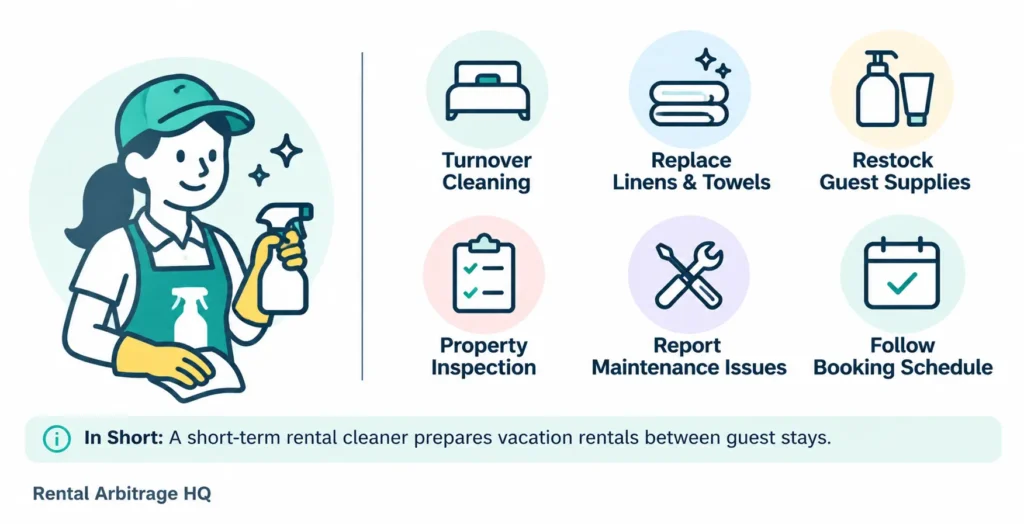
A short-term rental cleaner is a professional responsible for preparing furnished rental properties between guest stays. Unlike traditional house cleaners, these professionals often work according to reservation schedules and specific property instructions.
A short-term rental cleaner may perform several responsibilities:
- Complete turnover cleaning.
- Replace bed linens.
- Wash and organize towels.
- Restock guest supplies.
- Check for property damage.
- Report maintenance concerns.
- Prepare rooms according to host instructions.
- Confirm completion before guest arrival.
An Airbnb cleaning business should train employees to understand the difference between ordinary residential cleaning and hospitality-focused turnover preparation. Reliability, communication, attention to detail, and punctuality are particularly important in this type of work.
How to Manage and Scale an Airbnb Cleaning Business
Once a company develops a stable customer base, the next challenge is managing additional properties without reducing service quality. Growth should be based on operational capacity rather than simply accepting as many contracts as possible.
Hire and Train Reliable Employees
Employees should understand cleaning checklists, property access procedures, chemical safety, laundry handling, and guest-ready standards. Training should include practical demonstrations and quality inspections.
Introduce Cleaning Management Software
Scheduling and job management tools can help coordinate:
- Cleaning assignments.
- Employee availability.
- Property access details.
- Job completion status.
- Customer instructions.
- Invoices and payments.
A centralized system reduces communication problems as the business grows.
Establish Quality-Control Procedures
Every completed turnover should follow the same inspection process. Supervisors can review checklists, inspect selected properties, and monitor customer feedback. Consistent quality is particularly important when several cleaning teams work across different locations.
Develop Recurring Service Agreements
Recurring contracts can help a company plan staffing and estimate future revenue. The business should regularly review pricing to account for wage changes, supply costs, transportation, and additional service requirements.
Expand Into Additional Markets Carefully
An established Airbnb cleaning business may expand into nearby vacation rental markets once its scheduling and staffing systems are reliable. Expansion should be supported by customer demand, available employees, transportation arrangements, and sufficient working capital.
Final Thoughts
An Airbnb cleaning business can offer an accessible entry point into the short-term rental industry. The opportunity comes from helping hosts maintain clean, organized, and guest-ready properties without requiring the cleaning company to own or operate rental accommodations.
However, sustainable growth requires more than finding customers. A successful company needs proper registration, reliable employees, standardized cleaning procedures, competitive pricing, and dependable communication with property managers.
By combining turnover cleaning, housekeeping, laundry, and property inspection services, an Airbnb cleaning business can develop valuable long-term relationships with hosts and build a scalable service operation.
Frequently Asked Questions
- Is an Airbnb Cleaning Business Profitable?
- Yes, it can be profitable when the company secures regular cleaning contracts, controls operating expenses, and prices services appropriately. Profitability depends on turnover volume, labor costs, laundry, transportation, supplies, and overhead.
- How Much Money Is Needed to Start an Airbnb Cleaning Business?
- A small operation may begin with approximately $1,200–$3,200 in initial planning expenses, depending on equipment, registration, insurance, marketing, and transportation requirements. Actual costs vary by location and business model.
- What Licenses Are Needed to Start a Cleaning Business?
- Requirements vary by state, county, and city. Depending on the location, a company may need business registration, a local business license, tax registration, and applicable employee-related permits or compliance documentation.
- How to Get Airbnb Cleaning Contracts as a New Company?
- New cleaning companies can approach independent hosts, contact property management companies, develop local referral relationships, build a professional website, and offer trial cleaning services to demonstrate reliability.
- Does an Airbnb Cleaning Company Need Insurance?
- Insurance is strongly recommended. General liability coverage is particularly relevant because employees enter private properties and perform work that could potentially result in property damage or third-party injury claims. Other coverage may be necessary depending on staffing and transportation arrangements.
- Should Laundry Be Included in the Cleaning Price?
- It depends on the company's service model. Laundry can be included in a premium turnover package or charged separately. Separating the cost helps businesses account for washing, drying, folding, transportation, and linen replacement.
- What Is the Difference Between an Airbnb Cleaner and a Regular House Cleaner?
- A regular house cleaner generally works according to residential cleaning schedules. An Airbnb cleaner focuses on preparing properties between reservations, often within strict checkout and check-in windows, with additional responsibilities involving linens, restocking, and property inspections.